
Blog
Zeynep: meaning and rank in Turkey, 2018–2025
Our stored meanings for Zeynep, all marked plausible, the languages in our table, and TÜİK newborn ranks for each year from 2018 to 2025.
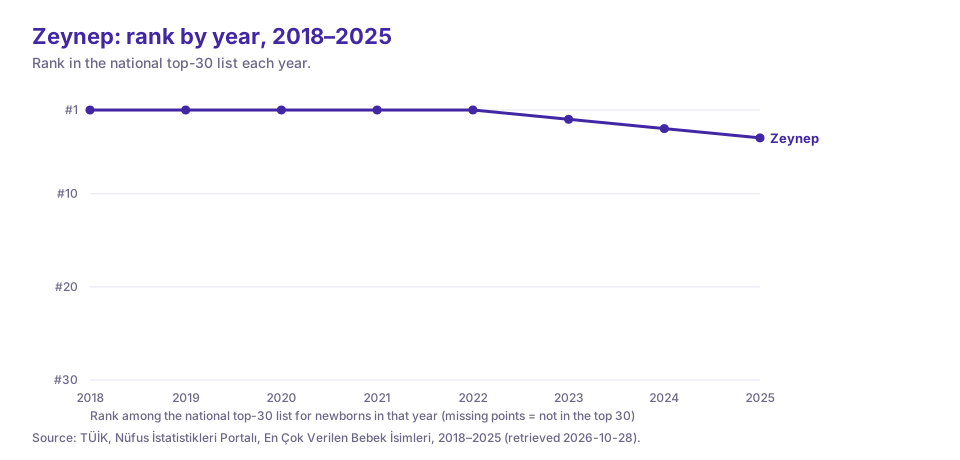
Zeynep was first on TÜİK’s national top-30 list for girls in each year from 2018 to 2022, and it stayed in the list through 2025. This guide sets out what our database records about its meaning, the languages where we list it, and its rank in each year.
What the name means
Our database holds several meaning entries for Zeynep. They are alternatives, not one agreed explanation, and every entry is recorded with the confidence level plausible.
- Fragrant flowering tree. This is the first entry. Our note says the meaning is traditionally given and its origin is debated.
- Her father’s jewel. This entry is recorded as a possible or popular etymology. Our note says it is not treated as established.
- A father’s precious jewel. A further entry, attributed to Bashkir, gives the same idea. Our note says not every part of it could be confirmed from its own Wiktionary entry.
- A namesake note. One more entry records the name of Prophet Muhammad’s wife, and of his daughter and granddaughter. It says who the name belongs to rather than what it means.
Some of these entries are still under editorial review. Our summary describes Zeynep as the Turkish form of the Arabic female name Zaynab.
Where the name is used
Our language table lists Zeynep for six languages: Azerbaijani, Bashkir, Kazakh, Turkish, Turkmen and Uyghur. The usage status is recorded as in use for Turkmen and as unknown for the others. For Kazakh, Turkish and Uyghur, the table also notes that Wiktionary lists it as a given name in that language’s section.
How often it was given in Turkey, 2018–2025
In TÜİK’s girls’ top-30 lists, Zeynep ranked as follows:
- 2018: rank 1, count 14,183
- 2019: rank 1, count 13,146
- 2020: rank 1, count 11,326
- 2021: rank 1, count 10,035
- 2022: rank 1, count 8,850
- 2023: rank 2, count 7,602
- 2024: rank 3, count 6,523
- 2025: rank 4, count 6,228
After five years at the top, its rank dropped by one place in each of the following three years, reaching fourth in 2025. It stayed in the top 30 throughout the period.
Where the data comes from
Ranks and counts come from TÜİK’s name statistics page, which covers the most-given newborn names for 2018–2025. Our chart uses the same national top-30 lists, and a year without a point means the name was not in that year’s top 30. The counts are births in those top-30 lists, not all births in Turkey. Meanings and languages come from our own database, and confidence levels are shown as stored.
Sources
- TÜİK (Turkish Statistical Institute) – newborn-name lists, 2018–2025